





 ‘s Report


Learn More
‘s Report
RIO™ Framework

The first step in understanding your RISA™ Profile is to understand its framework. Our RIO™ Map provides this framework. It is based on our research in the field of retirement income.
The RIO™ Map is comprised on the following factors:
- Your Goals
- Assets
- Retirement Funding Plan
- Liabilities
‘s Report
Your Goals

Let’s start with your goals. This is about being purposeful with your retirement, so we start with where you want to go and how your retirement income concerns affect them. We have narrowed goals down to four primary categories, which we call “The 4 L’s of Retirement.”
LongevityThese goals relate to ensuring you do not outlive your assets. Lifestyle
These goals include to how you want to live your life and focus on maintaining your desired standard of living. Legacy
These goals relate to leaving assets for subsequent generations or to charities. They also detail how impactful you want to be while alive. Liquidity
These goals involve maintaining enough reserves for unexpected contingencies. The proverbial need for the “rainy day” account.
Within your RISA™ Profile, we frame these as Your Retirement Concerns.
‘s Report
Your Assets
 Reliable Income
These sources are an essential part of drawing consistent income. Diversified Portfolio
This section covers your investment approach. Reserves
This part outlines how you want to handle contingency planning.
Reliable Income

Reliable Income sources are an essential part of drawing consistent income.
This section helps answer an essential retirement income planning question: “How can you create a reliable income floor that is safeguarded from market volatility?” These variables are used to offset essential expenses and longevity goals. They determine what kind of income floor you can count on.
‘s Report
Your Assets
Diversified Portfolio

Your Diversified Portfolio reviews your investments. It identifies how well you are positioned to effectively capture market rates of return, and how to practically manage your portfolio.
This section further helps you identify strengths and weaknesses in your own investment knowledge and application that could lead to good or poor outcomes. This portion significantly impacts your Lifestyle and Legacy goals.
Reserves

The Reserves section pertains to how well-positioned you can absorb any potential external shocks to your retirement income streams, such as job loss, unexpected death, chronic illness diagnosis, and much more.
We want to assess how you want to position yourself for contingencies such as these that can disrupt your retirement plans.
‘s Report
Retirement Funding Plan

Your Retirement Funding Plan section explores how coordinated is your plan. How do you envision yourself on this retirement income journey with regards to your retirement income distribution plan across your reliable income sources, investment portfolio, and reserve assets?
‘s Report
Liabilities

The Liabilities section of the RIO™ Map are the funds needed for your goals. Each goal type relates to a liability: Longevity Goals are related to essential expenses, Lifestyle goals are related to discretionary expenses, Legacy goals are related to legacy expenses, and Liquidity goals are related to contingencies.
This part of the RIO™ Map functions dynamically to ensure the Goals, Assets, and Income Funding strategies are continually aligned.
Your RISA™ profile is set against this framework in order to provide a clear understanding of how you can best proceed on your retirement income journey.
In the next section, we will review your RISA™ Profile with the first section of the RIO™ Map; your goals and retirement risks.
‘s Report
RISA™ Profile
Your RISA™ Profile is based on the following dimensions:

Your Probability versus Safety-First Dimensions
These dimensions detail how you prefer to source retirement income from your assets.
Probability-based income sources are dependent on the potential for market growth to continually provide you with a sustainable retirement income stream throughout your life. This includes a traditional investment portfolio or other assets that have the expectation of growth in order to subsidize your retirement income.
Safety-First income sources are dependent on contractual obligations for income. These sources of income are more immune from market swings. A safety-first approach may include protected sources of income common in pensions, most annuities, and individual bonds. This approach is not dependent on the expectation on probable market growth since the income is contractually driven.
‘s Report
RISA™ Profile
Your Optionality versus Commitment Dimension
These dimensions detail how flexible you prefer to be regarding your reliable income solutions.
Your Optionality dimension reflects a preference to keep your retirement income options open in case something more favorable develops in the future or your personal situation merits a change in your current plan. These include investment solutions that do not have pre-determined holding periods, can be sold expediently, and do not incur a meaningful loss of value resulting from the sale of the holding.
Your Commitment dimension reflects a preference to commit to retirement income solutions that resolve a retirement income need throughout your life regardless of your changing personal or economic developments. Your concern about avoiding potential negative developments, both personally and economically, as it relates to your ability to draw retirement income outweighs the potential benefits of more positive developments.
‘s Report
These dimensions combine to identify your RISA™ Profile.
They have reliably been shown to be significantly related to your retirement income concerns, strategy, tactics, income plan preference, and personal outcomes.
In the multidimensional view below, you can see how these factors complement each other very well.
 ‘s Report
We find that most RISA™ Profiles tend to be between the top right and bottom left quadrant. This is because our research shows that there is a significantly strong positive relationship between a Safety-First and Commitment oriented preference and significantly strong positive relationship between Probability-Based and Optionality oriented preferences.
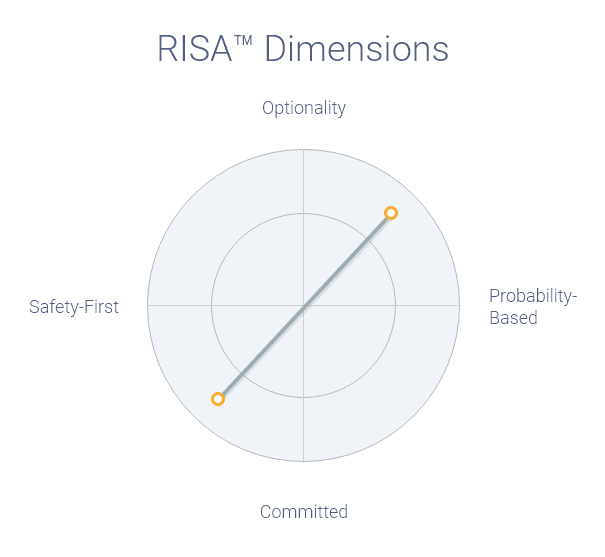
In the next section, we will discuss a framework for better understanding your RISA™ Profile within the context of a retirement income plan.
‘s Report
Your Retirement Concerns
Your RISA™ Profile reflects how you want to account for your goals and concerns when reviewing your retirement income plan. While there are many retirement goals, our RIO™ Map™ narrows them down to four primary categories, “The 4 L’s of Retirement.”
These not only represent your goals, but each come with their own set of retirement risks that can cause you great concern.
Longevity
Longevity goals and concerns are centered around addressing the main risk of retirement: outliving your money.
Most examples center on financial independence and knowing that you can pay your basic expenses and not be a burden to others. These include but are not limited to:
- Daily living expense
- Housing – Choosing your own living situation, such as staying in your home, downsizing, or moving somewhere new
- Healthcare – Being able to pay for your medical expenses throughout retirement
‘s Report
Your Retirement Concerns
Lifestyle
Lifestyle goals and concerns focus on maintaining your desired standard of living and enjoying your retirement with more discretionary spending. These goals require you to maximize your spending power.
In other words, this aspect of retirement planning is about maintaining your current or better lifestyle, rather than living too conservatively for your liking throughout retirement. This also includes being able to spend on others without impeding your retirement success.
Typical Lifestyle goals for you and your partner include:
- Travel & Leisure – taking trips, and doing fun activities
- Self-Improvement – Investing in your personal growth, such as taking classes and learning new skills
- Social Engagement – Enjoying the company of friends and family
- Vicarious Enjoyments – These can include assisting with tuition for the benefit of a family member or other
‘s Report
Your Retirement Concerns
Liquidity
Liquidity goals and concerns involve maintaining enough reserves for unexpected contingencies. This is the proverbial need for a rainy-day account.
Maintaining enough liquidity is especially important when it comes to:
- Supporting the family during emergencies
- Accounting for any repairs or home improvement necessities
- Accounting for an unexpected death (e.g., you or your partner)
- Accounting for an unexpected health event or illness
What if you were suddenly diagnosed with a chronic illness? It would most likely require a change in perspective and costs in retirement. Are you prepared?
‘s Report
Your Retirement Concerns
Legacy
Legacy goals and concerns are about leaving assets for subsequent generations or to charities, as well as contributing to impactful activities with your time and talent. The thought of leaving behind a legacy is a consistent theme here. While many people think of leaving a legacy as something that happens after you have passed, legacy goals can certainly occur while you are alive.
Typical goals include:
- Family Bequests – Leaving money to your family and doing so with minimal taxes and hassles
- Giving Back – Contributing to causes important to you with your time and financial assets
‘s Report
Your RISA™ Profile is significantly related to your Retirement Income Concerns.
Individuals more concerned with Lifestyle goals tend to identify with more Probability and Optionality based solutions. These solutions move toward the upper right RISA™ Quadrant because to address those concerns you need to take on more market risk and be more flexible with your income strategies.
 ‘s Report
Individuals more concerned with Longevity goals tend to identify with more Commitment oriented solutions. These solutions move toward the lower end of the RISA™ Quadrants because contractual income sources, like an annuity, may require a significant level of commitment to purchase.
 ‘s Report
RIO™ Framework – Reliable Income
 ‘s Report
While a general concern for all, individuals most concerned with Liquidity goals tend to identify with more Safety-First solutions. These solutions move toward the left side of the RISA™ Quadrants because safety-first income sources can readily provide the needed liquidity during the moments that require them. These solutions include but are not limited to cash options and insurance.
 ‘s Report
*An important note regarding how we view bonds within a bond ladders.
The discussion of bond ladders in this report specifically refers to using individual bonds to meet budgeted retirement expenses. We consider holding individual government bonds to maturity to generate desired cash flows to fund ongoing expenses throughout retirement. This attempts to protect your spending plan from volatility. We refer to bond ladders as sources of reliable income when they are part of a time segmentation strategy because they are risk-free, and you can directly match their yields and maturities with your expenses.
The use of bond ladders is a time segmentation strategy- also referred to as a bucketing approach. With a bucketing approach you establish a bond ladder to fund windows of expenses in retirement. These windows are dependent on your preferences, but they range from 1 to 3 years, 4 to 7 years, and more.
The role of bonds within your investment portfolio is different. The purpose of this type of bond vehicle, via bond funds or ETFs, is to dampen your portfolio’s overall volatility and not to serve as a direct source of reliable income. This type of bond approach is part of your asset allocation strategy in which you distribute a certain percentage from your investment portfolio each year to fund your retirement expenses. This is a total-return withdrawal strategy. When we provide suggestions to your investment portfolio’s bond allocation, we are only referring to the allocation of bonds within an investment portfolio.
‘s Report
While there is generally a low level of concern regarding legacy risks, individuals more concerned with Legacy goals tend to move toward more Commitment-oriented and Probability-based solutions. It seems that while individuals may commit to bequests by specifically earmarking assets, they do so with volatile investable assets. As an example, a parent may wish to make sure at all times that they can bequest a specific amount from their investment portfolio to their heirs.

In the next section, we will continue our progression through the RIO™ Map and how your RISA™ Profile corresponds to your Reliable Income strategy.
‘s Report
Your RISA™ & Reliable Income Strategy
As we move across the RIO™ Map, we can begin to identify your assets and how you utilize them in your retirement income plan. The RIO™ Map breaks your assets down into three categories: Reliable Income, Diversified Portfolio, and Reserves.
A nice way to think of the assets section of the RIO™ Map is:
Reliable Income
is for Safety
Diversified Portfolio
is for Growth
Reserves
are for shock absorption
Let’s start with the Reliable Income Section and your RISA™ Profile.
‘s Report
RIO™ Framework – Reliable Income
Reliable income sources are an essential part of drawing consistent income.
This section helps answer an essential question of retirement income planning: How can you create a reliable income floor that is safeguarded from market volatility?
Reliable income streams are used to offset essential expenses and fund longevity goals. They determine what kind of income floor in retirement you can count on regardless of any negative personal or economic developments.
This type of funding strategy applied to reliable income sources is broken down into two types. Funding an income floor for perpetuity or funding a floor for specific periods of time, time-based funding. Time-based funding strategies are frequently referred to as “bucketing strategies” in the popular press.
Your RISA™ Profile is significantly related to your Reliable Income strategy and tactics.
Our research shows that as your profile moves from the lower left to the upper right of the RISA™ Matrix your strategy preference will shift from more perpetuity-based solutions, like lifetime protected income from income annuities, to more time-based solutions.
‘s Report
These strategy preferences indicate how your tactics may be best used within your retirement income plan. Aligning your RISA™ profile and reliable income tactics help ensure that you can identify solutions according to your personal preferences.
The tactics used to implement your Reliable Income strategy are:
- Social Security
- Income Annuities
- Pensions
- Bond Ladders*
- Continued Employment
- Reverse Mortgage
We will detail these for you in your Retirement Funding Plan section.
In the next section, we will continue our progression through the RIO™ Map and how your RISA™ Profile corresponds to your Diversified Portfolio strategy.
‘s Report
Your RISA™ & Diversified Portfolio Strategy
The Diversified Portfolio section of the RIO™ Map identifies the degree to which you prefer to forecast future stock prices and market movements in order to maximize your retirement income.
Reliable Income
is for Safety
Diversified Portfolio
is for Growth
Reserves
are for shock absorption
Your diversified portfolio strategy identifies whether you believe in forecasting or whether you prefer to capture market returns without attempting to predict individual stock prices or general market cycles.
These beliefs affect your implementation preferences throughout all aspects of your investment portfolio. Retirement income from your diversified portfolio is largely used to offset discretionary expenses and any remaining essential expenses not covered by reliable income sources. We classify these investment preferences within your portfolio as Forecasting and Non-Forecasting strategy approaches.
Your RISA™ Profile™ is significantly related to your Diversified Portfolio strategy and tactics.
While most individuals identify as favoring a non-forecasting approach across all RISA™ quadrants, research shows that as you move from the top quadrants to the lower ones your forecasting orientation increases. We find two possible reasons for this. For some, previous negative forecasting experiences may lead to a greater appreciation for solutions that protect or hedge against future forecasts. Solutions with these protections are located towards the lower end of the RISA™ Matrix. For others, forecasting leads to a greater desire to hold and maintain an investment based on a forecasted expectation. This leads to viewing that investment with a stronger sense commitment, as opposed to a passive index which is a more agnostic choice.
‘s Report
Your RISA™ & Diversified Portfolio Strategy

You want to identify and assemble a list of diversified portfolio tactics so you can see the ones that align with your RISA™ Profile™. Aligning your RISA™ Profile and diversified portfolio tactics help ensure that you can identify solutions according to your personal preferences.
The tactics used to implement your Diversified Portfolio strategy are:
- Overall asset allocation
- Stock selection
- Bond Selection
- Alternative assets
- Tax management
We will detail these for you in your Retirement Funding Plan section.
In the next section, we will continue our progression through the RIO™ map and how your RISA™ Profile™ corresponds to your Reserves strategy.
‘s Report
Your RISA™ & Reserves Strategy
Your Reserves section of the map identifies how you prefer to address any potential external spending shocks to your retirement income streams, such as a chronic illness, unexpected death, or other unforeseeable costly events. While your reserves section is not intended for your ongoing retirement income needs, having a plan for potential spending shocks helps you maintain the income plan in place without significant interruption.
Reliable Income
is for Safety
Diversified Portfolio
is for Growth
Reserves
are for shock absorption
The two main strategies that address this center on your liquidity preferences.
There are two main types of liquidity preferences. Those who prefer true liquidity like to have assets earmarked specifically for future unknown events that can derail a retirement income plan. This involves the use of cash set asides, buffer assets, and insurance. Those who prefer technical liquidity would rather raise cash from investments or assets already earmarked for other goals in order to fund emergencies.
Your RISA™ Profile is significantly related to your Reserves Strategy and Tactics.
While most individuals favor a true liquidity-based approach across all quadrants, our research shows that as your profile moves from the upper left to the lower right quadrant of the RISA™ matrix your orientation starts to shift toward a greater appreciation for technical liquidity-based solutions. For example, cash-based solutions tend to be utilized with a more Optionality and Safety-First orientation. Relying on an investment portfolio, with pre-assigned priorities, to handle contingencies reflects a more probability-based and committed-oriented preference.
‘s Report
Your RISA™ & Reserves Strategy

You want to identify and assemble a list of reserves tactics so you can see the ones that align with your RISA™ Profile. Aligning your RISA™ profile and reliable income tactics help ensure that you can identify solutions according to your personal preferences.
The tactics used to implement your Reserves strategy are:
- Cash & Income Sources
- Insurance Utilization
- Housing & Aging in Place Issues
- Health Planning
- Estate Planning Basics